Water Filter
Andrew's Project Portfolio
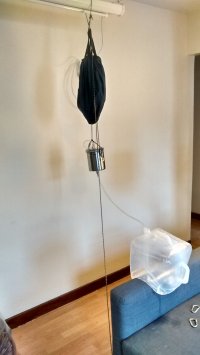
I recently designed & built this water filtration system based on a prototype I made & tested several years ago when bicycle camping with a group of friends. This updated version is polished and is more modular, effective, inexpensive and reusable.
Note: If you plan to build one of these, as with any item used for camping, kindly TEST it before you go on your trip.
Highlights
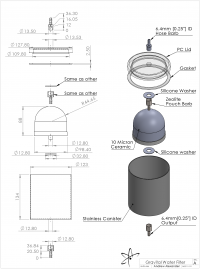
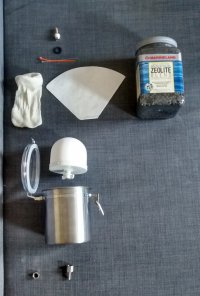
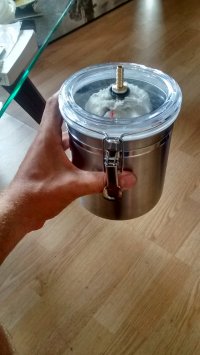
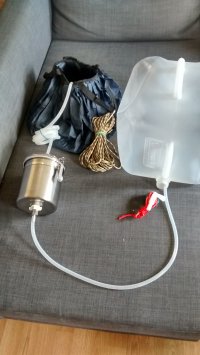
Design
When "roughing it", you wind up making a choice for hydration:
- Bring a limited large, heavy plastic containers of potable water
- Use similarly-limited water sterilization tablets to sterilize containers of water from around the campsite.
I came up with a third option, use a gravity-powered self-contained water filtration system to detoxify and purify water from around the campsite. The advantages are numerous:
- relatively unlimited water processing
- light weight
- High-quality sediment, bacteria & heavy metal-free water
- Modularity
- reusablity
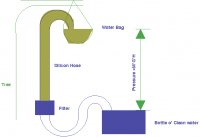 Because this system will be supporting more than a couple of people, flow-rate needs to be high if one assumes each person will drink approx. 4.5L (1 US Gal) per day. To enhance the flow-rate without use of pumps, a simple gravitational potential system is used. Hoist a bag of water high into a tree, $P=\rho \cdot G \cdot H$ and thus more water is forced using a passive system. This means my 5 gallon water jug can be filled even while we're all sleeping.
There are still obvious dangers though, this filter handles down to 10 micron (10000 nm) which is smaller than bacteria, but virii are small enough (down to 20nm!) to get past this filter. The next version will use ionic silver in some form to handle virii, based on this paper. That said, rainfall in the areas around the City of New York are relatively clean of particulates and presumably virii based on reports sourced from the New York State Dept. of Environmental Conservation.
Fabrication
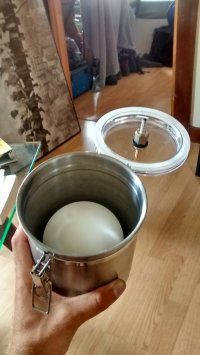 Building this filter is straight-forward. After marking the center accurately, I used a center punch & step-drill to create the holes in the top of the plastic/stainless housing. After deburring the steel & plastic to remove sharp edges, I inserted the ceramic filter, put a bit of PTFE tape along the exposed threads protruding from the bottom and put the outlet hose barb on. I did the same with the top, noting that the silicon washer needed to go on the inside of the lid before attaching the two PTFE-taped hose barbs together.
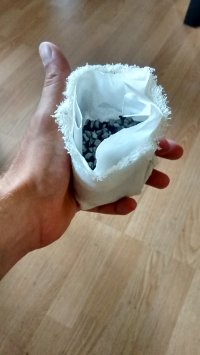 I made the filter sock which also holds the carbon/zeolite using a #6 conical coffee filter stuffed into the most forward part of a thin cotton sock, trimmed the sock & filter to a horizontal level and filled it a little more than halfway with the carbon/zeolite mix.
Zip-tie the top of the pouch onto the exposed hose barb twice, tightly, and you're pretty much done.
Results
As of July 12th I haven't gone on my trip yet, with that said this system is based on a uch uglier prototype I bult using plastic containers and a Brita filter which was fully successful, as such I cannot see why this version would fail.
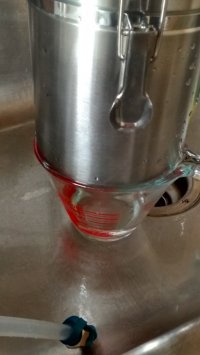 Flow-rate is dependent on the height of the bag of unfiltered water. To ball park what flow-rates I could obtain, I measured how long it took for water to flow through the filter and reach the 100ml mark, which wound up taking 2 minutes & 17 seconds.
If it took 2:17 (or 137s) at almost no pressure, that can be approximated as 2.63L/hr. If one uses the calculations for water 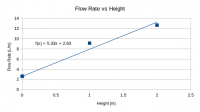 flow-rate through an orifice of 1mm diameter, a height of 1 meter above the filter would impart 9.8kPa of pressure, which should yield approximately 9.14 L/hr. Assuming gravity has a linear effect, and that no hoses or containers are able to flex against the imparted pressure, the flow-rate can be approximated as $Q=5.33 \cdot h + 2.63$ for any height h below, say, 5 meters.